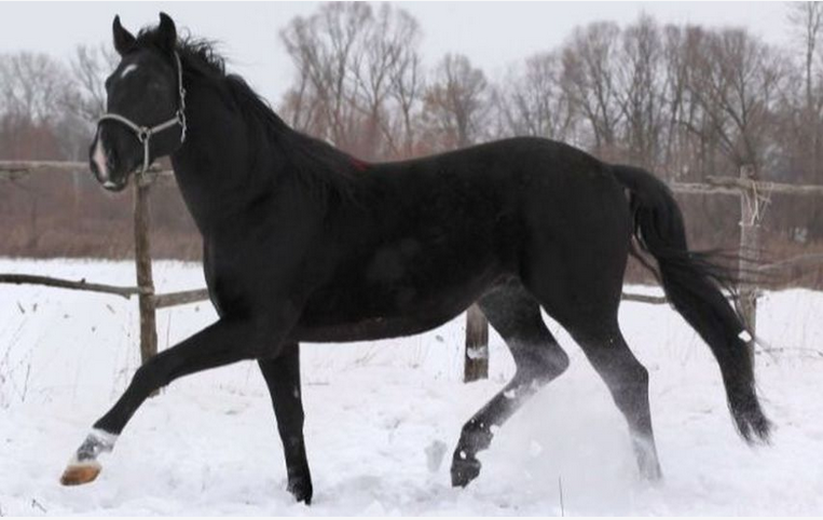
Horses can be left or right 'handed', just like humans.
Here's why it matters.
Photo Credit: Google Image Search, Labeled for Reuse
One of the first things we discover about ourselves is whether we are right- or left-handed. It makes a huge difference which hand we use when we try to write, throw a ball, or use a hammer. The same is true for our legs: If we're right handed, we typically also feel more balanced and secure if we lead with our right leg.
Researchers have e found that horse have a preferred side of the body, just like humans. This is different from their having a "stiff" and "hollow" side, something most horse owners already know. (More about that here.)
Handedness (or laterality, as it is referred to when applied to horses) means they prefer either the right or left lead when performing a variety of activities, such as cantering, stepping up, or jumping. Knowing which side your horse prefers can make an enormous difference to the success of your training.
In one study, 40 horses (males = 20, females = 20) were tested to see if they showed signs of right or left laterality. The experimental procedures included watching horses as they moved freely or when ridden and noting which foreleg was most frequently used to initiate movement (walk or trot), or to avoid obstacles within a passageway. They also allowed them to roll and noted which direction they preferred.
The results were surprising: They not only found clear evidence of laterality in the majority of horses, but there was also a pronounced sex difference. Male horses exhibited significantly more left lateralised responses and female horses exhibited significantly more right lateralised responses. The results were published in the scientific journal Applied Animal Behavioral Science.
Researchers have e found that horse have a preferred side of the body, just like humans. This is different from their having a "stiff" and "hollow" side, something most horse owners already know. (More about that here.)
Handedness (or laterality, as it is referred to when applied to horses) means they prefer either the right or left lead when performing a variety of activities, such as cantering, stepping up, or jumping. Knowing which side your horse prefers can make an enormous difference to the success of your training.
In one study, 40 horses (males = 20, females = 20) were tested to see if they showed signs of right or left laterality. The experimental procedures included watching horses as they moved freely or when ridden and noting which foreleg was most frequently used to initiate movement (walk or trot), or to avoid obstacles within a passageway. They also allowed them to roll and noted which direction they preferred.
The results were surprising: They not only found clear evidence of laterality in the majority of horses, but there was also a pronounced sex difference. Male horses exhibited significantly more left lateralised responses and female horses exhibited significantly more right lateralised responses. The results were published in the scientific journal Applied Animal Behavioral Science.
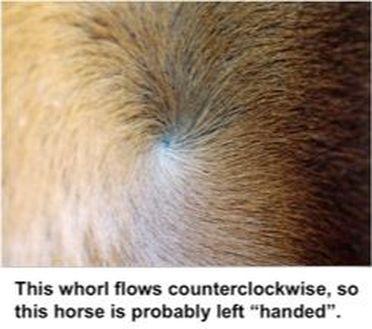
It turns out that there is an even easier way to tell which side your horse prefers: Just look at your horse's facial whorls and see which way they flow. The picture to the left shows a facial whorl on a horse's forehead. It flows counterclockwise, so this horse is probably left lateralized. If it flowed clockwise, the horse would probably be right lateralized.
Sound strange, right? Except that this regularity has been measured, recorded, and published in several scientific journals of equine behavior.
In one study, trainers classified 219 horses in terms of whether each horse had a preference for performing (galloping, jumping, dressage movements) on either the left or right rein or if there was no detectable difference while being ridden (meaning the horse was well-balanced or ‘ambidextrous’).
The results showed that 43% were found to prefer the right lead, 47% preferred the left, and the remaining 10% were ambidextrous (balanced). They also found differences between males and female. Just as in the previous study, males tended to prefer the left, while females tended to prefer the right.
But the most striking results was that the researchers discovered that they could predict a horse's preference by examining facial whorl patterns: Those with a right-preference had significantly more clockwise whorls, while those with left-lead preferences had whorls that flowed in a counter-clockwise direction. (You can read the entire study here.)
As strange as this all sounds, the researchers point out that this information could prove handy to trainers. For example, left-preferences thoroughbreds probably have an advantage on the race track, since the tracks always run to the left.
It is also important to horse riding training and horse handling. Why? Because if you introduce new skills to your horse on the left, you will find you have much less resistance. Think of it this way: If someone were trying to teach you how to perform a new exercise, would it be easier for you if tried it first using your right hand/leg or your left?
Most of us learn things faster when we practice it first with our preferred side. The same is true for horses. So this is a valuable horse training tip for saving yourself some time and your horse some frustration!
Happy riding!
Copyright Denise Cummins, March 11, 2016; Updated June 18, 2018
Sound strange, right? Except that this regularity has been measured, recorded, and published in several scientific journals of equine behavior.
In one study, trainers classified 219 horses in terms of whether each horse had a preference for performing (galloping, jumping, dressage movements) on either the left or right rein or if there was no detectable difference while being ridden (meaning the horse was well-balanced or ‘ambidextrous’).
The results showed that 43% were found to prefer the right lead, 47% preferred the left, and the remaining 10% were ambidextrous (balanced). They also found differences between males and female. Just as in the previous study, males tended to prefer the left, while females tended to prefer the right.
But the most striking results was that the researchers discovered that they could predict a horse's preference by examining facial whorl patterns: Those with a right-preference had significantly more clockwise whorls, while those with left-lead preferences had whorls that flowed in a counter-clockwise direction. (You can read the entire study here.)
As strange as this all sounds, the researchers point out that this information could prove handy to trainers. For example, left-preferences thoroughbreds probably have an advantage on the race track, since the tracks always run to the left.
It is also important to horse riding training and horse handling. Why? Because if you introduce new skills to your horse on the left, you will find you have much less resistance. Think of it this way: If someone were trying to teach you how to perform a new exercise, would it be easier for you if tried it first using your right hand/leg or your left?
Most of us learn things faster when we practice it first with our preferred side. The same is true for horses. So this is a valuable horse training tip for saving yourself some time and your horse some frustration!
Happy riding!
Copyright Denise Cummins, March 11, 2016; Updated June 18, 2018
Here are some books, videos, and products that I recommend. Clicking on the photos will take you to Amazon.com where you can get more information about them and purchase them.
  |
  |
  |
  |
  |
  |
  |
  |
|
Oster Grooming Kit
|
Troxel Helmet
|
Tough 1 Sports Boots
|
Cashel Crusader
Fly Mask |
