|
|
Feeding a horse needn't be guessing game. Here are the most frequent questions horse owners have, and the best answers according to the latest research.
HOW MANY CALORIES DOES A HORSE REALLY NEED?
An average 1,000 horse that is worked lightly needs about 20,000 calories a day. If this 1,000 horse is a lactating mare, her caloric needs balloon to 40,000 calories a day.
HOW DO THESE CALORIES TRANSLATE INTO FEEDING REGIMENS?
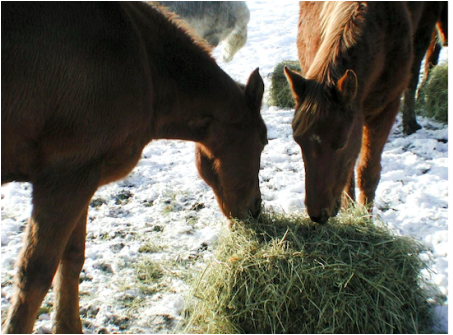
The foundation of feeding a horse should be quality forage—hay. The minimum daily hay requirement to avoid colic is 1% of body weight (10 lbs of hay for a 1,000 lb horse). A normal daily intake is 1.5% of body weight (15 lbs for a 1,000 lb horse). A performance horse that is worked frequently requires 2% of body weight (or 20 lbs of hay daily).
WHAT OTHER NUTRITIONAL NEEDS DO HORSES HAVE?
Do be careful about feeding a horse protein. They need about 700 grams of protein daily, most of which they can readily get from quality hay. But other nutrients may have to be gotten from equine supplements.
Horses need about 30 grams of lysine daily, along with vitamin E and A. These nutrients are not readily obtained from hay because vitamin A is lost in hay during storage and vitamin E values vary considerably among forages. Vitamin D is provided by exposure of horses to sunlight (and by sun-cured hays.) In contrast, B complex vitamins are synthesized in the horse's digestive tract, so these usually don’t have to be provided in the diet. Finally, exercising horses may need as much as 1 to 2 ounces of salt per day. This is why buying quality equine supplements or the best horse feed is crucial to good horse care.
WHAT ABOUT OATS? AREN'T THEY THE BEST FOOD FOR HORSES?
Feeding a horse oats? Not such a good idea. Oats are low in vitamins and other nutrients. For example, it would take 42 lbs of oats to provide the amount of vitamin E horses need daily, and 10 lbs to get enough lysine. Oats also have an inverted calcium-phosphorus ratio. Horses need calcium and phosphorus in a 2:1 ratio (twice as much calcium as phosphorus). But oats have a 1:5 ratio (five times as much phosphorus as calcium!).
Why is that a problem? The way to think about it is that for every gram of phosphorus ingested in the diet, the horse’s body must match it with another gram of calcium or else the phosphorus won’t be absorbed. If the required calcium isn’t available in the horse’s diet, the body will grab it from wherever it can---such as from bones! So feeding oats puts your horse’s skeletal structure at risk.
The best way to ensure that your horse gets the nutrients she needs in the right ratio is to feed a quality feed concentrate or equine supplement daily.
WHAT ABOUT BEET PULP? ISN'T THAT REALLY HIGH IN CARBS?
Because beets are high in sugar, people tend to think that beet pulp must be very high in carbs. But it isn't. Beet pulp is the fibrous matter that is leftover after the sugar is extracted from beets. It is highly digestible and offers many nutritional benefits. One caveat: Always soak your beet pulp to avoid choke. Here is a great article that gives you all the facts about beet pulp.
WHAT ABOUT FATS? DOESN'T FEEDING FAT TO A HORSE MAKE THE HORSE FAT?
Horses need good quality fats in their diet--fats like omega fatty acids or rice bran oil. It makes their coats shiny, prevents "tying up" (painful muscle spasms) , puts quality weight on hard keepers (without over stressing their metabolisms with too much carbohydrate), and gives the sluggish horse an energy boost. Simply add a high quality omega fatty acid supplement to your horse's feed (click here for a good one) or pour some rice bran oil on your horse's feed (click here for a good brand of rice bran oil). Start with half a cup and increase to a cup or more daily, depending on your horse's activity level. Read more about these four benefits of fat here.
Copyright Denise Cummins, PhD February 2016
HOW MANY CALORIES DOES A HORSE REALLY NEED?
An average 1,000 horse that is worked lightly needs about 20,000 calories a day. If this 1,000 horse is a lactating mare, her caloric needs balloon to 40,000 calories a day.
HOW DO THESE CALORIES TRANSLATE INTO FEEDING REGIMENS?
The foundation of feeding a horse should be quality forage—hay. The minimum daily hay requirement to avoid colic is 1% of body weight (10 lbs of hay for a 1,000 lb horse). A normal daily intake is 1.5% of body weight (15 lbs for a 1,000 lb horse). A performance horse that is worked frequently requires 2% of body weight (or 20 lbs of hay daily).
WHAT OTHER NUTRITIONAL NEEDS DO HORSES HAVE?
Do be careful about feeding a horse protein. They need about 700 grams of protein daily, most of which they can readily get from quality hay. But other nutrients may have to be gotten from equine supplements.
Horses need about 30 grams of lysine daily, along with vitamin E and A. These nutrients are not readily obtained from hay because vitamin A is lost in hay during storage and vitamin E values vary considerably among forages. Vitamin D is provided by exposure of horses to sunlight (and by sun-cured hays.) In contrast, B complex vitamins are synthesized in the horse's digestive tract, so these usually don’t have to be provided in the diet. Finally, exercising horses may need as much as 1 to 2 ounces of salt per day. This is why buying quality equine supplements or the best horse feed is crucial to good horse care.
WHAT ABOUT OATS? AREN'T THEY THE BEST FOOD FOR HORSES?
Feeding a horse oats? Not such a good idea. Oats are low in vitamins and other nutrients. For example, it would take 42 lbs of oats to provide the amount of vitamin E horses need daily, and 10 lbs to get enough lysine. Oats also have an inverted calcium-phosphorus ratio. Horses need calcium and phosphorus in a 2:1 ratio (twice as much calcium as phosphorus). But oats have a 1:5 ratio (five times as much phosphorus as calcium!).
Why is that a problem? The way to think about it is that for every gram of phosphorus ingested in the diet, the horse’s body must match it with another gram of calcium or else the phosphorus won’t be absorbed. If the required calcium isn’t available in the horse’s diet, the body will grab it from wherever it can---such as from bones! So feeding oats puts your horse’s skeletal structure at risk.
The best way to ensure that your horse gets the nutrients she needs in the right ratio is to feed a quality feed concentrate or equine supplement daily.
WHAT ABOUT BEET PULP? ISN'T THAT REALLY HIGH IN CARBS?
Because beets are high in sugar, people tend to think that beet pulp must be very high in carbs. But it isn't. Beet pulp is the fibrous matter that is leftover after the sugar is extracted from beets. It is highly digestible and offers many nutritional benefits. One caveat: Always soak your beet pulp to avoid choke. Here is a great article that gives you all the facts about beet pulp.
WHAT ABOUT FATS? DOESN'T FEEDING FAT TO A HORSE MAKE THE HORSE FAT?
Horses need good quality fats in their diet--fats like omega fatty acids or rice bran oil. It makes their coats shiny, prevents "tying up" (painful muscle spasms) , puts quality weight on hard keepers (without over stressing their metabolisms with too much carbohydrate), and gives the sluggish horse an energy boost. Simply add a high quality omega fatty acid supplement to your horse's feed (click here for a good one) or pour some rice bran oil on your horse's feed (click here for a good brand of rice bran oil). Start with half a cup and increase to a cup or more daily, depending on your horse's activity level. Read more about these four benefits of fat here.
Copyright Denise Cummins, PhD February 2016
Here are some books and products that I recommend. The feed products are ones that I have fed my own horses for years. Clicking on the photo will take you to Amazon.com where you can get more info and purchase them.
  |
  |
  |
  |
  |
  |
  |
  |
  |
  |
  |
